The CDC reports that about half of children and youth with autism were reported to wander; one in four of those children was missing long enough to cause concern.
Read the CDC guidance SynodosCare ReadyComing Soon
 Caregiver-prepared. Responder-directed.
Essential care information, ready for the moment it is needed.
Synodos Care Ready helps caregivers securely maintain essential information for someone they care for and quickly create a responder-facing or care-provider-facing brief when needed.
iPhone testing underway · Not yet publicly downloadable
Local-firstNo accountNo subscription
Why
Preparation begins with understanding the need.
Care Ready is grounded in real response experience, the realities of caregiving, and evidence showing how prepared information may help across many different circumstances.
Why Care Ready exists
Built from both sides of the response.
Care Ready grew from two parts of my life: nearly 20 years responding to and investigating missing-person, abduction, medical, and safety incidents as a first responder—and my experience as the parent of a child with special needs.
I know what responders need in the first critical minutes. I also understand how difficult it can be for a caregiver to organize those answers while someone they love needs help.
I am funding Care Ready personally, without advertisers, investors, subscriptions, or a business model built around caregiver information.
The meaning behind Synodos Path
Synodos (σύνοδος) is a Greek word, formed from syn (“together”) and hodos (“way” or “journey”)—literally, “journeying together.” As a Greek American, I chose the name “Synodos Path” because it captures the shared path at the heart of this mission: helping families, caregivers, and responders prepare and move forward together.
Preparation across a lifetime
Caregiving is not limited to a diagnosis.
Every parent, guardian, and trusted caregiver may need to share the right information—for a routine appointment, school activity, temporary caregiver, aging parent, or unexpected emergency. The goal is not to expect the worst. It is to avoid having to remember everything at once when the stakes are high.
Supporting research and statistics
Facts that show why preparation matters.
These figures are not predictions about any one family, and not every person represented needs a caregiver. They show the breadth of circumstances in which prepared information may help.
In 2025, NCMEC supported 32,167 reports of missing children. One in seven children reported missing was considered a likely victim of child sex trafficking.
Read the NCMEC dataSix in 10 people living with dementia will wander at least once, and many do so repeatedly. Families are advised to keep a recent photograph and likely destinations ready.
Read the Alzheimer’s Association guidanceWHO reports that 57 million people were living with dementia worldwide in 2021. An earlier WHO projection estimated 139 million by 2050. Alzheimer disease may contribute to 60–70% of dementia cases.
Read the WHO fact sheet Read the 2021 projectionIn 2025, the VA recorded 3.16 million service-connected mental disability ratings, including 1.76 million for PTSD. These are condition ratings, not a count of unique veterans.
Read the VA reportA 2025 meta-analysis of 138 studies estimated PTSD prevalence at 14.3% among active first responders with routine exposure to potentially traumatic events.
Read the systematic reviewHow Care Ready Works
Prepared once. Reviewed for the situation.
Caregivers are not asked to recreate stored information during an event. The app combines the existing Care Ready Profile with current, situation-specific details.
Create a Care Ready Profile.
Securely maintain essential information for the person you care for before it is urgently needed.
Select Emergency or Everyday Care.
Choose the path that matches the current situation.
Review what matters now.
Confirm stored information and add only the situation-specific facts that are relevant.
Create and share the right brief.
Create an Incident Brief for an emergency or an Information Brief for Everyday Care.
Care Ready Profile
Maintain the information that changes slowly.
The caregiver reviews the profile before sharing and adds only the facts that belong to the current situation.
- Identification and physical details
- Medical conditions, medications, and allergies
- Communication information
- Sensory considerations and calming methods
- Behavioral, functional, and safety information
- Emergency contacts
Inside Care Ready
A focused path from preparation to sharing.
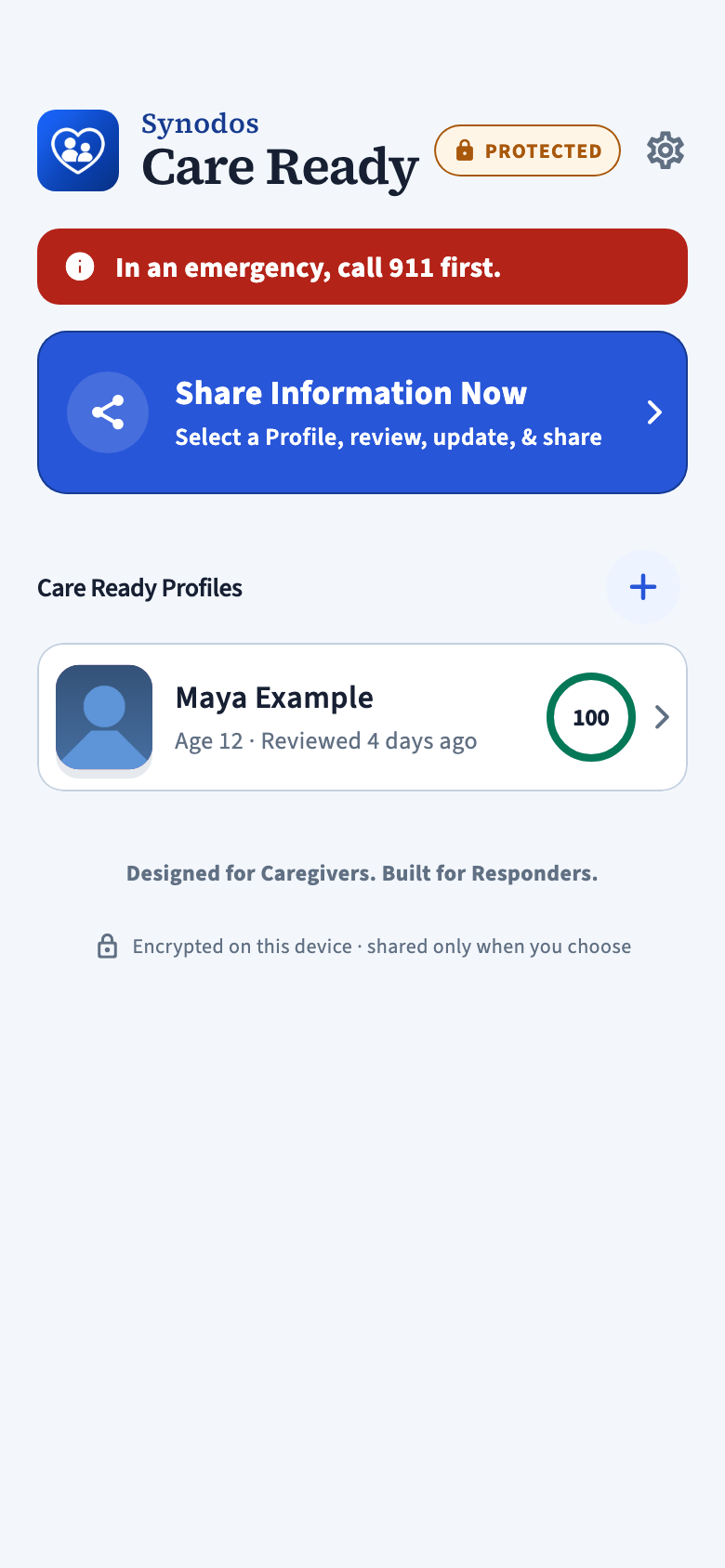
These captures of the current iPhone interface use fictional test data. They show profiles, caregiver contacts, and an incident brief; testing is still underway.
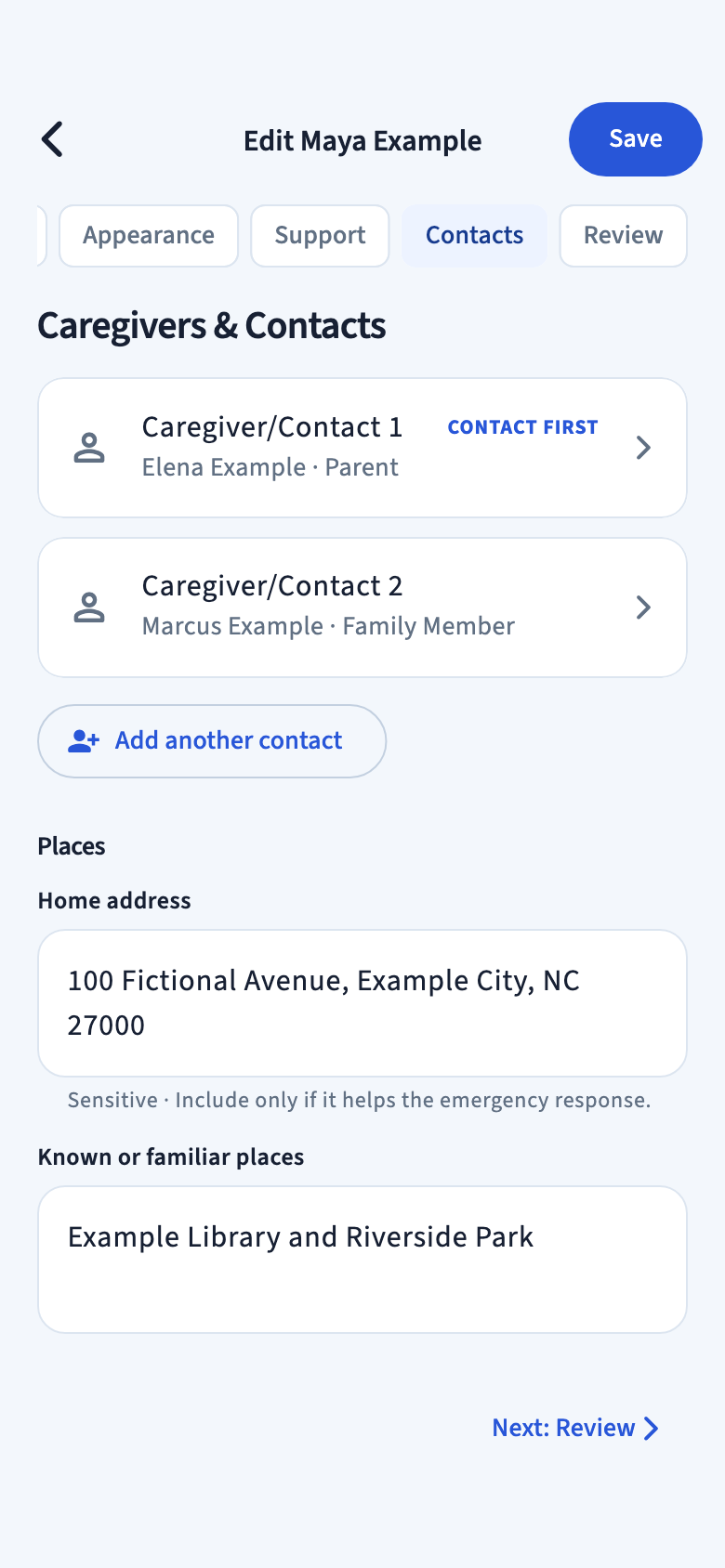
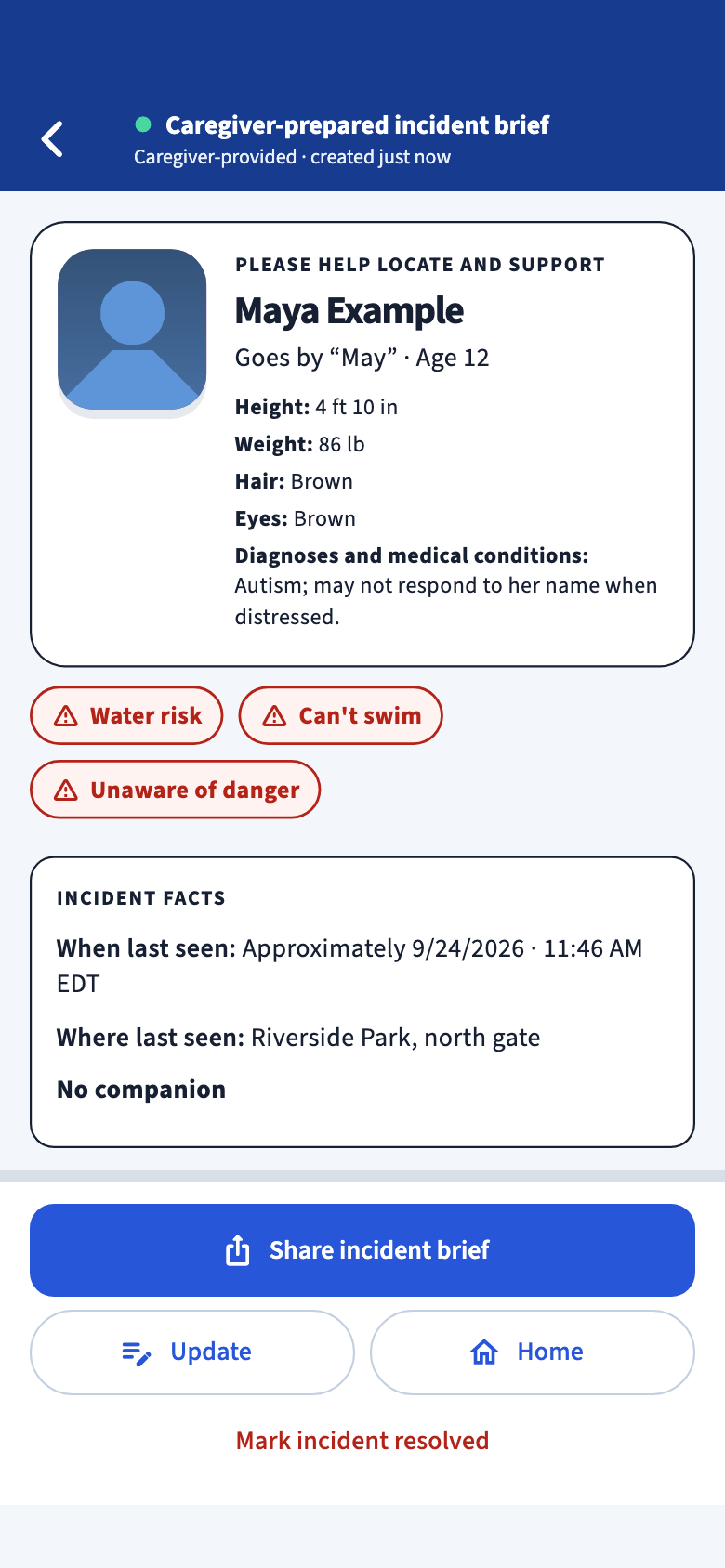
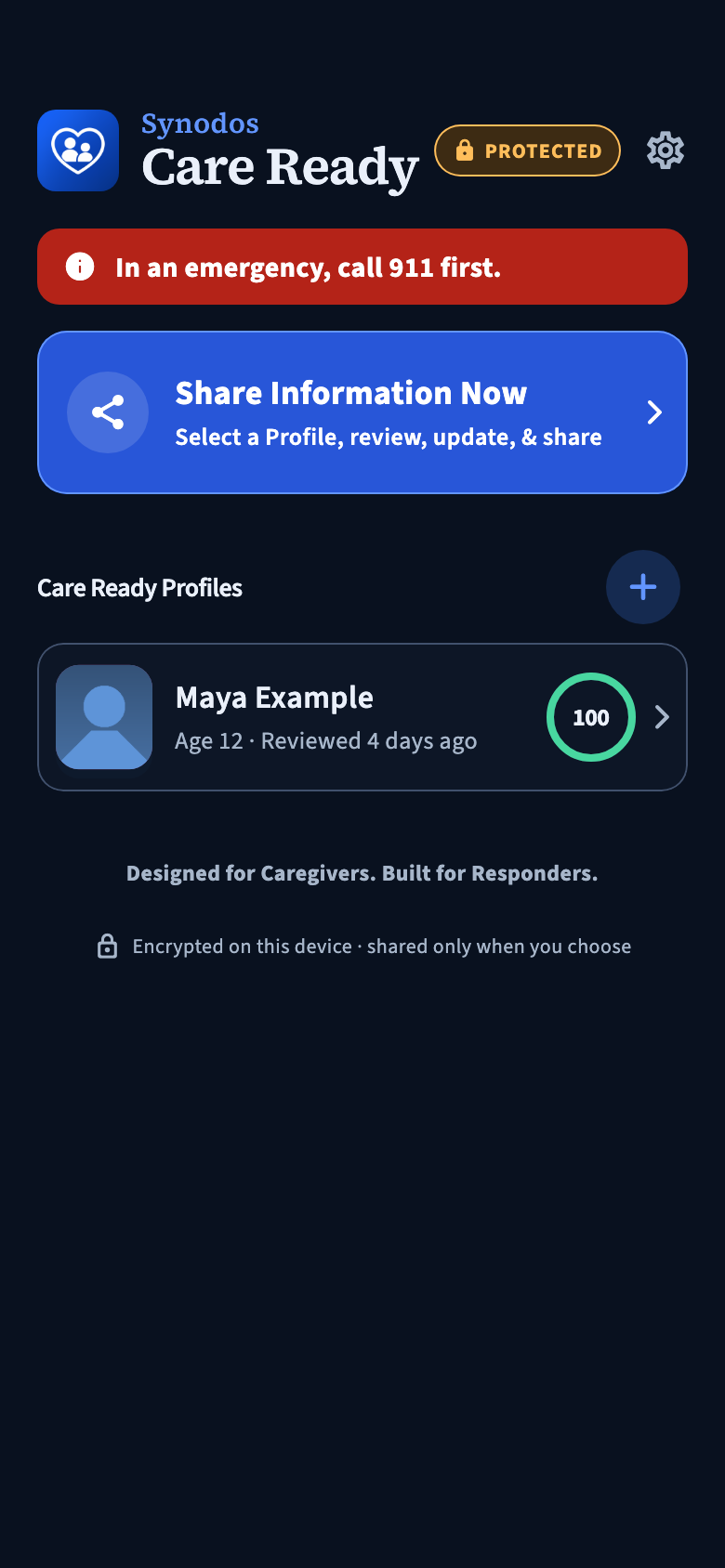
All names, photographs, and profile information shown are fictitious sample data.
For Caregivers
Designed for Caregivers.
Maintain information while life is calm, choose the path that matches the situation, review the brief, and control when it is shared.
- A separate Care Ready Profile for each person
- Focused questions matched to the situation
- Emergency and Everyday Care pathways
- Caregiver review before sharing
For Responders
Designed to Support Responders.
An Incident Brief is caregiver-prepared and responder-directed. It organizes information that may support safe, responder-led assessment and action without changing responder authority.
01
Current identification and physical details
02
Last-known time, place, and clothing when relevant
03
Current medical urgency, medications, and allergies
04
Communication, sensory, and safe-approach information
05
Current risks that may affect search or responder safety
06
Caregiver-provided facts captured close to the event
Two clear paths
Emergency or Everyday Care.
Each workflow limits the review to information relevant to the current situation.
EmergencyCreates an Incident Brief
Emergency workflows prioritize the small number of current facts that may help with identification, immediate dissemination, search planning, current risk, responder safety, and safe recovery.
- Abduction
- Missing or Lost Person
- Elopement
- Runaway
- Medical — Paramedics or Emergency Room
- Immediate Safety Concern
Responder consideration—not an eligibility determination.
The app may identify facts that could support consideration of an AMBER Alert or an Endangered Missing Person Advisory. Alert names and requirements vary by jurisdiction. Only authorized law-enforcement or public-safety personnel determine eligibility and activate an alert. Care Ready does not issue or request public alerts.
Everyday CareCreates an Information Brief
Everyday Care is part of emergency preparation. Routine use helps caregivers keep information current and build familiarity with selecting, reviewing, creating, and sharing an appropriate brief.
- Medical Appointment or Walk-in
- Temporary Caregiver — Family, Friend, or Sitter
- School or Daycare
- Activity — Sports, Arts, or Events
- Travel
- Respite Care
- Family-Care Handoff
Familiarity under calm creates confidence under stress.
Repetition builds procedural memory and can reduce cognitive burden during an actual emergency. Immediate Safety Concern remains an Emergency pathway when someone may be in immediate danger.
Routine use builds emergency readiness.
Privacy and caregiver control
Local-first. Account-free. Shared by choice.
Care Ready does not require a Synodos account or subscription. Profile information is encrypted locally on the device, and Synodos does not operate a cloud database containing Care Ready Profiles.
The iPhone test build excludes its working database from ordinary device/iCloud backup. You can create an encrypted backup and keep its separate recovery code. Both are needed to recover records. The owner has accepted the iPhone physical checks. Broader release testing continues.
No Synodos account required
No subscription required
Profile information encrypted locally
No Synodos profile database
Caregiver chooses when to share
Encrypted backup file + separate recovery code
Encrypted profile copy for another caregiver
Frequently asked questions
Clear purpose.
Clear boundaries.
Caregiver-prepared. Responder-directed. The caregiver controls when information is shared.
What is Synodos Care Ready?
A local-first mobile application that helps caregivers securely maintain essential information and create a focused brief for an emergency or Everyday Care situation.
Who is it for?
Parents, guardians, family members, and other trusted caregivers responsible for a child or adult. Care Ready is built around care and safety needs, not a diagnosis, age, or family type.
What is a Care Ready Profile?
The maintained information a caregiver may need to review or share, including identification, medical, communication, sensory, behavioral, functional, safety, and emergency-contact information.
Does a caregiver recreate the profile during an event?
No. Care Ready combines the existing Care Ready Profile with the small number of current details relevant to the situation. The caregiver reviews the information before creating a brief.
What is the difference between an Incident Brief and an Information Brief?
An Incident Brief is created for an Emergency workflow and is intended to support responder-led action. An Information Brief is created for Everyday Care and supports an appropriate care handoff.
What is Brief History?
Brief History is the app’s on-device history of Incident Briefs and Everyday Care Information Briefs created by the caregiver. The caregiver should still review the current Care Ready Profile and situation-specific facts before creating or sharing a new brief.
Does Care Ready contact 911 or track someone?
No. It does not contact emergency services, track or locate a person, investigate an incident, determine alert eligibility, or replace first responders. Contact emergency services directly when someone is missing, injured, or in immediate danger.
Does Synodos operate a cloud database of profiles?
No. Care Ready is local-first and account-free. Profile information is encrypted locally on the device. The iPhone test build excludes its working database from ordinary device/iCloud backup. Backup & Recovery creates an encrypted file and a separate recovery code; both are needed to restore records. The owner has accepted the iPhone physical checks; broader release testing continues.
When is information shared?
Only when the caregiver chooses. A brief should be reviewed for accuracy and shared only with an intended recipient through a method available in their installed build.
Can another caregiver have the same profile?
Yes, on iPhone. Send an encrypted profile copy with the iPhone share sheet and give the sharing code separately. Each caregiver’s copy is independent, so later changes don’t sync. Version 1.0 does not include a responder QR code.
Does Care Ready determine whether an alert should be issued?
No. The app may identify facts that could support responder consideration of an AMBER Alert or Endangered Missing Person Advisory. Alert names and requirements vary, and only authorized public-safety personnel determine eligibility and activate an alert.
Does this website track visitors?
Synodos Path uses no visitor analytics, advertising trackers, tracking cookies, session recording, fingerprinting, or behavioral profiling on this website. Hosting infrastructure may process limited technical request data needed to operate and secure the site.
Is the app available now?
iPhone testing is underway and private TestFlight testing is being prepared. The app is not publicly downloadable or approved for external TestFlight testing yet. Android work will resume after iOS is complete.
Current availability
iPhone testing is underway.
Private TestFlight testing is being prepared; Apple approval and invitations are not yet available. Current testing uses fictional records. Care Ready is not publicly downloadable. Android work will resume after iOS is complete.
Care Ready supports preparation. It does not replace action.
The app does not contact 911, track a person, investigate an incident, determine alert eligibility, or replace first responders. Contact emergency services directly when someone is missing, injured, or in immediate danger.
App inquiriescareready-inquiries@synodospath.com
Availability and general questions about Care Ready.
App supportcareready-support@synodospath.com
Testing, technical, accessibility, privacy, and policy support.Report the screen, steps, expected result, and what happened. Include your app version and iPhone model. Never email medical, identifying, emergency, or profile information.